Contact
Tbilisi 0144,
59/4 Ketevan Dedofali Ave/ Lekh Kaczynski Str., 0144, Tbilisi
Tel/Fax: +995 32 2921667
E-mail: post@comcom.ge
Phone number
+995 32 2921667
ComCom Joins UNESCO’s Global Media and Information Literacy Week for the Sixth Consecutive Year

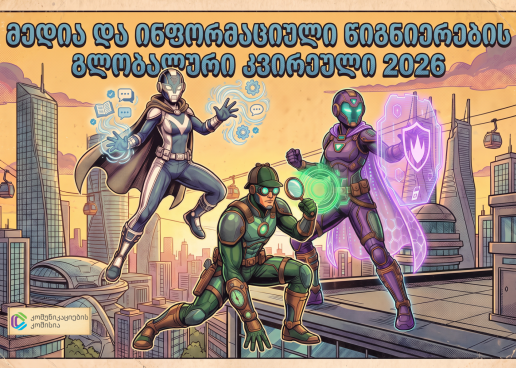
The Communications Commission is joining UNESCO’s Global Media and Information Literacy Week, observed annually in late October, for the sixth time, offering the public a diverse range of activities. Organised by ComCom, the event will take place from 26 to 30 October and feature educational and interactive activities tailored to different audiences. As part of the programme, ComCom and its partners will host thematic webinars, while schools across the country will celebrate Media Literacy Day. The week will conclude with a forum.
This year’s theme for the Global Media and Information Literacy Week is “We All Play a Part.” The theme highlights that building a media-literate society and creating a safe information environment is a shared responsibility involving the public and private sectors, the education sector, civil society and each citizen.
In today’s digital environment, people are not only recipients of information but also its creators and distributors. Critical thinking, fact checking, digital safety and responsible communication are therefore becoming increasingly important. The activities planned by ComCom aim to draw public attention to these issues and provide practical knowledge to different target groups.
The central event of the week will be the Media and Information Literacy Forum, bringing together organisations working in media literacy, teachers and other interested individuals. Developed around this year’s central message, the forum aims not only to provide information on media literacy, but also to encourage participants to reflect on their own roles and engage actively in the process.
The event will feature a panel discussion entitled “Media and Information Literacy as a Shared Responsibility.” Participants will discuss the role of different sectors in building a media-literate society, existing experience, and opportunities to strengthen cooperation.
An important part of the forum will be the presentation of the national media literacy standard and guidelines, which aim to support the development of media literacy education and integrate the relevant knowledge and practical skills into the educational process.
As part of Global Media and Information Literacy Week, ComCom and its partner organisations are also offering four free webinars, open to anyone interested.
On 26 October at 17:00, ComCom and the Ministry of Education, Science and Youth of Georgia will host a webinar for school principals and teachers entitled “How to Teach Media Literacy: The New National Standard and Guidelines.” Participants will learn about the new national media literacy standard, its practical application, and the guidelines developed for teachers.
On 27 October at 17:00, ComCom and the Digital Governance Agency will hold a webinar entitled “Cyber Hygiene and Safe Internet Use.” The webinar will cover the ways to protect personal information and online accounts, create secure passwords, identify suspicious links and messages, and follow practical recommendations for protecting against online fraud.
On 28 October at 13:00, a webinar entitled “Child Online Safety” will be held in cooperation with the United Nations Children’s Fund (UNICEF). The session will address the main challenges to the safety of children and adolescents in the digital environment, the associated risks, and the role of parents and teachers in creating safe online experiences for children. The webinar will be conducted in English, with Georgian interpretation provided.
On 30 October at 17:00, a webinar entitled “From Media Literacy to Innovation: How Is an Idea Created and Developed?” will be held in cooperation with the Georgian Innovation and Technology Agency (GITA). The session will focus on generating and developing ideas, critically assessing problems and opportunities, and using artificial intelligence and modern technologies to turn innovative ideas into reality.
The participation of schools across Georgia will once again be an important part of the week. As part of Media Literacy Day, students and teachers will take part in a variety of educational and practical activities. They will discuss how to distinguish reliable information from misinformation, verify information, behave safely in the digital environment and use artificial intelligence responsibly. They will also create thematic projects and develop their media literacy skills through practical exercises.
Global Media and Information Literacy Week is an international UNESCO initiative aimed at raising awareness of the importance of media and information literacy and promoting cooperation among government institutions, educational organisations, civil society, the private sector and citizens.