Contact
Tbilisi 0144,
50/18 Ketevan Tsamebuli Ave/ Bochorma Str., 0144, Tbilisi
Tel/Fax: +995 32 2921667
E-mail: post@comcom.ge
Phone number
+995 32 2921667
ComCom Announces the Winners of the Media Literacy Olympiad and Awards them with a Media Lab

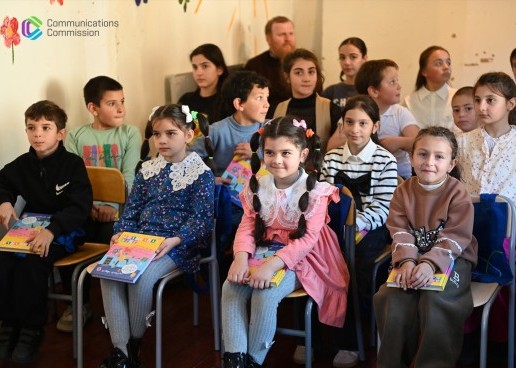
The Communications Commission has announced the winners of the second Media Literacy Olympiad for teachers and students – Lakhamula Public School in the Municipality of Mestia and Public School N1 in Batumi – and awarded them with a modern media laboratory. The Commission also presented both schools with other high-tech prizes such as an interactive whiteboard and a laptop, as well as a mobile phone stand, microphone, and LED lighting. In addition, a common area was set up in the schools where students will be able to use technology and create high-quality media products. The competition attracted nearly 350 entries, with over 2,100 students and 300 teachers taking part. The theme of this year's competition was Artificial Intelligence (AI) and Disinformation.
15 students from the public school of the village of Lakhamula village school, which won the I-V grade category, took part in the competition. The school won with a fun and creative video prepared for the Olympiad, which shows how the students created a photo manipulation using artificial intelligence, and then told their friends a fake story about famous football players visiting the village of Lakhamula. The students, together with their teacher, explained the methods used to identify the photos created with AI, talked about the importance of verifying the source, and highlighted the tools needed to verify photo manipulation. It is worth noting that there are currently 22 pupils enrolled at the public school in Lakhamula.
The senior category was won by the team of 19 VI grade pupils of Public School N1 in Batumi, who also presented their work in the form of a video. The creative and educational video was partially created by artificial intelligence, highlighting the capabilities of AI. In the video, the pupils discussed the role of media literacy in the age of artificial intelligence and noted that AI can be both a threat and a useful tool, depending on the user and their goals. Notably, the team was headed by a teacher who had been trained in media literacy teaching as part of ComCom’s “Integrating Media Literacy into Formal Education” project.
Participants had to develop a creative and informative response to the question “Artificial Intelligence and Disinformation – Challenge or Opportunity?” in the form of a video, presentation, comic, or digital poster. In addition to the winners, the ten best entries from the competition were placed on ComCom's media literacy platform.
The Communications Commission held the first edition of the Media Literacy Olympiad last year, attracting more than 500 submissions. The panel selected two winners: St. George International School of Tbilisi and Kutaisi Public School No. 45.
The Media Literacy Olympiad is held within the framework of UNESCO's Media and Information Literacy Week, which serves to raise awareness about media literacy and its importance in the society. For the Communications Commission, as the body responsible for the development of media literacy in the country, involving more stakeholders and citizens in this process represents one of the priorities.